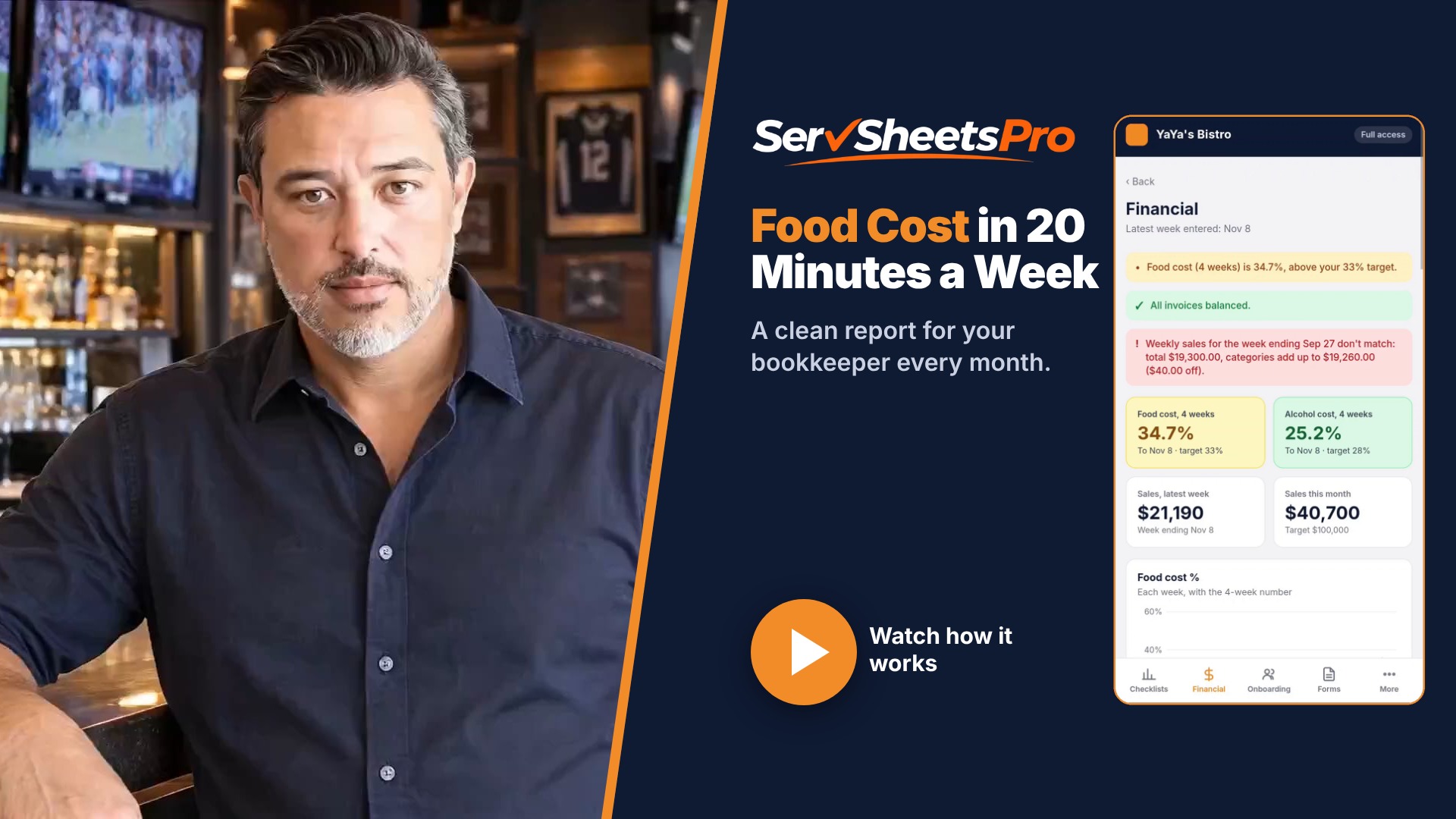
How to Track Restaurant Food Cost Without Weekly Inventory Counts
Whether you run a restaurant, a bar, a food truck, a coffee shop or a donut shop, food cost is where your money leaks. When I started in this industry, tracking it meant counting everything, every week. Today I track it without a weekly inventory count, and I still bring food cost down. Here's how food cost tracking has changed, the formulas behind it, and the simpler system I use now.
How we used to track food cost
Years ago, we tracked cost of goods by category: food, liquor, beer, wine. If you did a weekly count, you were ahead of the curve. As long as you kept up your weekly counts and tracked by category, your numbers were pretty accurate.
The formula is the same one accountants still use:
Cost of goods sold = beginning inventory + purchases − ending inventory
Food cost % = cost of goods sold ÷ food sales × 100
Example: you start the week with $4,000 in food on the shelves, buy $9,000, and end with $3,500. Your cost of goods sold is $9,500. If food sales were $32,000, your food cost is about 29.7%.
It works. But it only works if someone counts everything, accurately, every single week.
Then came variance tracking
Next, companies started selling variance tracking. Variance compares what you should have used to what you actually used:
Theoretical usage = what your recipes say you used, based on what you sold
Actual usage = beginning inventory + purchases − ending inventory
Variance = actual usage − theoretical usage
Variance is tracked by product and by recipe. A drink at happy hour is a different recipe from the same drink at full price: it uses the same amount of inventory, but it earns a different amount of money. Variance shows you the dollars earned against the amount used, item by item.
It's handy. It's also tedious.
Weighing bottles and counting hot dogs
Up until about four or five years ago, we weighed our liquor bottles and counted individual hot dogs and buns. We ran key item inventories on the expensive things that tended to go missing: Veuve Clicquot, boxes of carne asada, frozen items once they were pre-portioned, and our biggest sellers, like cases and bottles of Jameson and individual bottles of Bud Light.
That's a lot of hours every week, and a lot of hours that don't make you money.
Is variance tracking worth it?
For most independent places, no. Managing every single item by recipe for variance is overwhelming, and the benefits don't outweigh the labor and the headache. Stop stepping over dollars to pick up a dime.
It's worth it if you're extremely high volume, or if you run several locations and share inventory between them. In that case, you probably need a more robust inventory system anyway, like MarginEdge.
If you're an independent restaurant doing under about a million a year, you probably don't need a weekly inventory count. Your accountant may still want a count at year end, so keep doing that one.
The 4-week rolling food cost
Here's what I use now. Instead of counting, I track food and alcohol cost as a rolling 4-week number: total purchases over the last 4 weeks ÷ total sales over the last 4 weeks.
Why 4 weeks? Because a single week lies. If you only divide one week's purchases by one week's sales, all of these throw your number off:
A big party or a busy holiday
Pre-ordering before a holiday, when your vendors won't deliver
Over-ordering one week
A power outage or a slow week, so you're sitting on extra inventory
Over 4 weeks, those swings level out. That was the key.
It works because most restaurants order back to par. Week to week and season to season, your orders are more consistent than you think. In the summer you order more bottles of beer. In the winter you sell more Jägerbombs. The same goes for food. Once you see the trend, anything off-trend stands out, like a missed invoice, a sales mistake or product walking out the back door.
How to lower food cost without counting everything
Set a realistic food cost goal and an alcohol cost goal. Then shave the number down over time:
Tighten up your ordering. Order to par, not to habit.
Raise prices where your costs have gone up.
Adjust portion sizes and keep them consistent.
Cost your recipes so your menu prices are right. You don't have to run your whole inventory through recipes to do this.
Ring discounts and comps into your POS properly, so your sales numbers are real.
Track waste as much as you can.
Watch the rolling number after each change. If it drops and stays down, the change worked.
Keep your shelves lean
Anything sitting on a shelf is dollars, not inventory. Two rules I run by:
Kitchen: never have more food than you need until the next delivery. Run your storage areas down as close to zero as you can before the truck comes.
Bar: never have more than two weeks of backstock.
Lean shelves mean less spoilage, less waste and less product that can disappear.
Accountability makes it stick
Tracking trends, tight ordering, accurate recipe costs, consistent portions and clean POS numbers beat variance tracking for most independent places. Not because the method is fancier, but because it actually gets done every week. And without the hours spent on intensive inventory counts.
Just bought a place? Here's why weekly food cost belongs in your first week.
You don't need to be there. You need to be aware.
How the ServSheets Pro Food Cost System does it
About 20 minutes a week. A manager enters weekly sales and invoices from their phone.
Rolling 4-week food and alcohol cost against the goals you set. Over your goal, your numbers turn red. Close to it, yellow. Under it, green.
Your bookkeeper gets a monthly report automatically, so the owner, the bar manager, the restaurant manager and the bookkeeper are all on the same page. Here's what to look for in a restaurant bookkeeper, and what it should cost.
No weekly inventory count. No POS connection and no invoice scanning either. That keeps it simple and keeps the price one-time.
It works for restaurants, bars, food trucks, coffee shops and donut shops. Food cost tracking is not accounting software and is not a substitute for professional accounting advice.
Frequently asked questions
What's the formula for food cost? Cost of goods sold (beginning inventory + purchases − ending inventory) ÷ food sales × 100.
Can I track food cost without counting inventory? Yes. A rolling 4-week number, total purchases ÷ total sales over 4 weeks, shows your trend without a weekly count. Keep a year-end count for your accountant.
What is food cost variance? The difference between what you actually used and what your recipes say you should have used. It's useful for high-volume and multi-location operations, and usually not worth the labor for independent places.
Does this work for food trucks and coffee shops? Yes. Anyone who buys product and sells it can track a rolling food and beverage cost.
Want to try it? The ServSheets Pro Food Cost System is $149 one-time, or $297 with the Checklist and Onboarding & Training systems. We set it up for you. See how the Food Cost System works →
